HOW TO GROW A YOUTUBE CHANNEL: SIMPLE GUIDE FOR 2026
- Karan Mishra
- No Comments
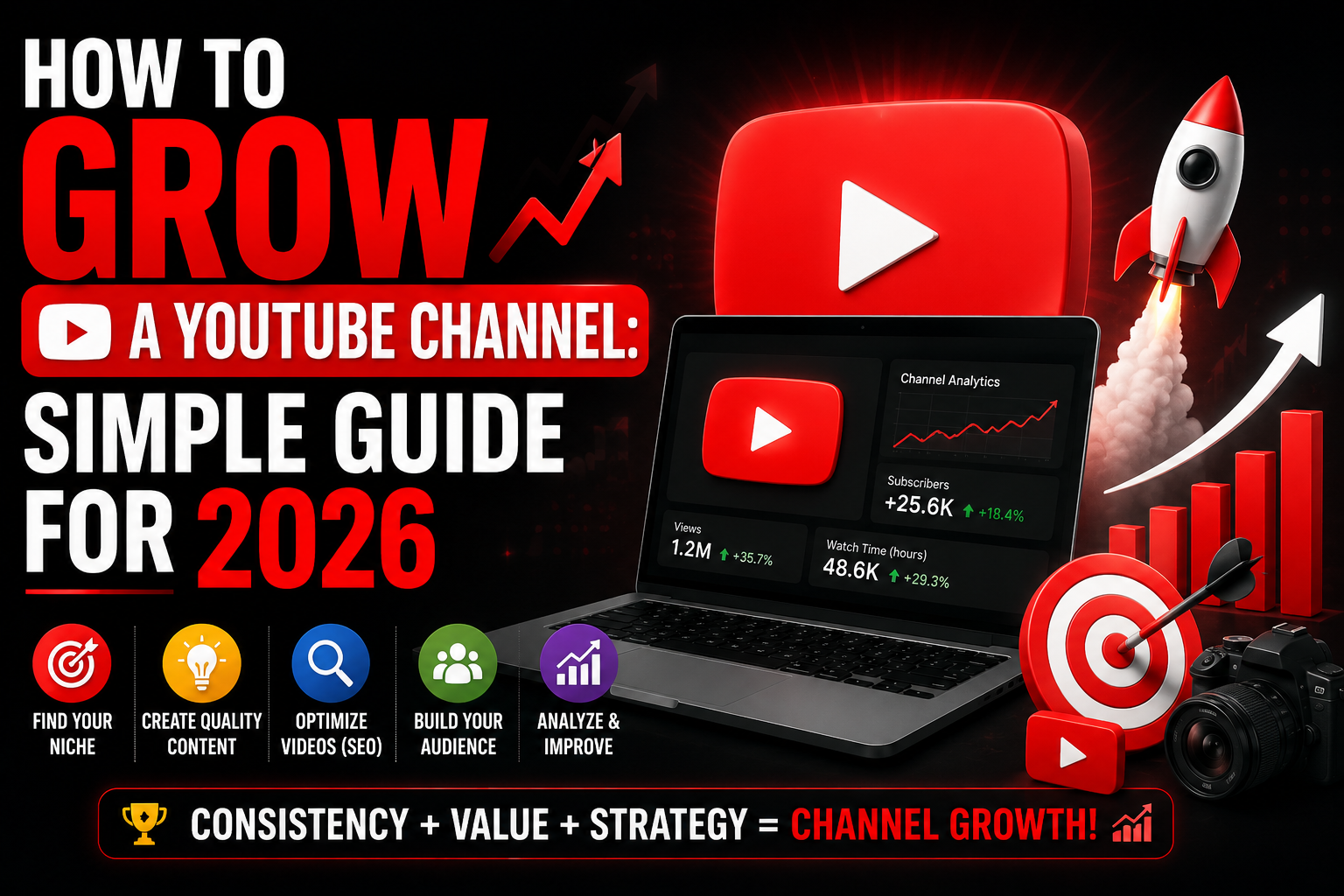
Table of Contents
INTRODUCTION
If you are thinking about how to grow a YouTube channel, the first thing you need is not random videos. You need a proper content plan.
Many beginners upload videos whenever they get an idea. Because of this, their content can become random and difficult to manage.
A better approach is to choose one main topic and create related content around it.
In simple words:
Main Topic → Related Topics → Useful Content → Connected Content
This approach can help you keep your YouTube content more organized.
In this blog, we will understand how beginners can plan their YouTube content and build a simple content structure around one main topic.
WHAT DOES IT MEAN TO GROW A YOUTUBE CHANNEL?
Growing a YouTube channel means building a proper content system around a clear topic and creating useful content for your audience.
For beginners, the first step should be understanding what type of content they want to create.
For example, if your main topic is Digital Marketing, you can create different videos around:
SEO
Google Ads
Social Media Marketing
Email Marketing
Content Marketing
YouTube Marketing
Instead of creating completely random videos, these topics can become part of one larger content structure.
CHOOSE ONE MAIN TOPIC
The first step is to choose a broad topic for your channel.
This can become your main or pillar topic.
For example:
Pillar Topic: Digital Marketing
After choosing the main topic, you can find smaller topics related to it.
This makes your content planning easier because you do not have to think about a completely new topic every time you want to create a video.
The Blog Clusterization guide explains this simple idea as:
Main Topic + Related Topics = Blog Cluster
The same planning approach can be used for organizing YouTube content.
FIND RELATED YOUTUBE TOPICS
After choosing your main topic, make a list of related topics.
For example:
MAIN TOPIC
Digital Marketing
RELATED TOPICS
What is SEO?
What is Google Ads?
What is Social Media Marketing?
What is Email Marketing?
What is Content Marketing?
How to Start Digital Marketing?
These related topics can become separate videos.
This gives you multiple content ideas from one main topic.
CREATE A YOUTUBE CONTENT CLUSTER
A content cluster means that your content is connected around one main subject.
For example:
PILLAR TOPIC
Digital Marketing Complete Guide
SUPPORTING VIDEOS
What is SEO?
What is Google Ads?
Social Media Marketing Basics
Email Marketing for Beginners
What is Content Marketing?
The main topic gives the overall information, while the supporting topics explain specific parts.
This is the same pillar and supporting structure explained in the Blog Clusterization guide.
WHY CONTENT CLUSTERING IS USEFUL FOR YOUTUBE
A connected content structure can make your content planning easier.
Instead of asking:
“What video should I make today?”
You already have related topics planned around your main subject.
It can also help you:
Plan content more easily
Keep related videos connected
Cover different parts of one topic
Find missing topics
Repurpose content into other formats
For example, one YouTube video can also give you ideas for:
A blog
Instagram post
LinkedIn post
Carousel
Short video
Newsletter
This follows the content planning and repurposing approach from the Blog Clusterization guide.
USE ONE CLEAR CONTENT DIRECTION
Your channel should have a clear content direction.
If your channel is about digital marketing, your videos should mainly stay connected to digital marketing.
You can cover different subtopics, but they should still make sense together.
For example:
Digital Marketing
→ SEO
→ Google Ads
→ Social Media Marketing
→ Email Marketing
→ Content Marketing
This creates a content family around one main subject.
PLAN YOUR CONTENT BEFORE CREATING VIDEOS
Content planning can save time.
Instead of creating videos randomly, follow a simple process.
STEP 1: CHOOSE YOUR MAIN TOPIC
Choose one broad topic for your channel.
STEP 2: LIST RELATED TOPICS
Write down important questions, subtopics and smaller areas related to your main topic.
STEP 3: SELECT PILLAR AND SUPPORTING TOPICS
Keep the broad topic as the pillar and use specific topics as supporting content.
STEP 4: CREATE AND CONNECT CONTENT
Create useful videos and connect them naturally with other relevant content.
This four-step process follows the exact content-cluster approach from the Blog Clusterization guide.
KEEP YOUR CONTENT SIMPLE
Good content does not always need complicated language.
Use simple words and explain the topic in a way that beginners can understand.
For example, instead of using a complicated explanation of SEO, explain the basic idea first and then move towards deeper topics.
Short paragraphs and clear points also make your written content easier to read.
The same readability approach is recommended in the Yoast guide: use short paragraphs, simple language, shorter sentences and active voice.
USE KEYWORDS NATURALLY
Keywords help you keep your content focused.
For this blog, the focus keyphrase is:
How to Grow a YouTube Channel
The keyphrase is used naturally in the:
SEO title
URL
Meta description
Introduction
Main heading
Relevant content
Do not repeat the same keyphrase in every sentence.
Keyword stuffing can make content look unnatural.
The Yoast guide specifically recommends natural keyword placement and warns against keyword stuffing.
CREATE SUPPORTING CONTENT AROUND YOUTUBE GROWTH
If your main pillar topic is:
PILLAR
How to Grow a YouTube Channel
You can create supporting topics such as:
YouTube Content Planning
YouTube SEO for Beginners
YouTube Monetization Policy
YouTube Shorts Guide
YouTube Keyword Research
YouTube Analytics for Beginners
This gives you a proper YouTube content cluster.
Each supporting topic can explain one specific part of growing a channel.
CONNECT YOUR RELATED CONTENT
When you have multiple related articles or pages, connect them naturally.
For example, this blog can connect with your other content about:
YouTube Monetization Policy
YouTube SEO
Digital Marketing
Content Marketing
This helps create a connected content structure.
Internal linking is also included in the Yoast on-page SEO guidance because relevant internal links help connect pages and support website navigation.
IMAGE OPTIMIZATION FOR THIS BLOG
Images should also be optimized properly.
Do not use random image file names.
Use a meaningful file name such as:
Image File Name: how-to-grow-youtube-channel.jpg
Image ALT Text: How to grow a YouTube channel
The image should also be compressed so that the page can load faster.
This follows the image optimization guidance from the Yoast PDF.
COMMON CONTENT MISTAKES
1. CREATING RANDOM CONTENT
Random topics can make content planning difficult.
Instead, choose a main topic and build related content around it.
2. NO CONTENT STRUCTURE
Without a clear structure, it can become difficult to cover all important parts of a topic.
3. USING KEYWORDS TOO MUCH
Do not force the same keyword into every paragraph.
Use natural variations where they make sense.
4. MAKING CONTENT TOO COMPLICATED
Keep the language simple and easy to understand.
5. NOT CONNECTING RELATED CONTENT
If you have related blogs or pages, connect them naturally through relevant internal links.
SIMPLE YOUTUBE CONTENT PLAN FOR BEGINNERS
If you are a beginner, start small.
You can begin with one main topic and around 4–6 supporting content ideas.
For example:
PILLAR: How to Grow a YouTube Channel
SUPPORTING CONTENT:
YouTube Content Planning for Beginners
YouTube SEO for Beginners
YouTube Keyword Research
YouTube Monetization Policy
YouTube Shorts Guide
YouTube Analytics for Beginners
Later, you can add more relevant topics to the cluster.
This follows the beginner approach recommended in the Blog Clusterization guide.
ON-PAGE SEO CHECKLIST
Before publishing this blog, check the following points:
Focus keyphrase is selected
Focus keyphrase is in the SEO title
SEO title is within the recommended 50–60 character range
URL is short and clean
Focus keyphrase is included in the URL
Meta description is around 150–160 characters
Focus keyphrase is included in the meta description
H1 is used only once
H2 headings are used for main sections
H3 headings are used for sub-sections
Focus keyphrase appears naturally in the first 100 words
Focus keyphrase appears in a relevant heading
Image file name is meaningful
Image ALT text is descriptive
Images are compressed
Relevant internal links are added
Trusted external links are added where relevant
Paragraphs are short
Sentences are simple
Active voice is preferred
Transition words are used naturally
Keyword stuffing is avoided
Content is easy for the reader to understand
Page should be mobile-friendly and fast-loading
These points are based on the on-page SEO checklist and guidance in the Yoast PDF.
FINAL CONTENT STRUCTURE
The complete content structure can be remembered like this:
MAIN TOPIC
↓
RELATED TOPICS
↓
PILLAR + SUPPORTING CONTENT
↓
USEFUL CONTENT
↓
CONNECTED CONTENT
This is the main idea behind blog clusterization and organized content planning.
CONCLUSION
If you are thinking about how to grow a YouTube channel, start with a proper content plan instead of creating random videos.
Choose one main topic.
Then find related topics and turn them into supporting content.
Keep your content simple, useful and connected.
At the same time, use basic SEO practices such as a clear focus keyphrase, proper headings, clean URLs, optimized images, relevant links and readable content.
The simple formula is:
Main Topic → Related Topics → Useful Content → Connected Content
This can give beginners a much more organized way to plan their YouTube content.
CALL TO ACTION
Want to learn more about YouTube, SEO, digital marketing and content creation?
JOIN VIDYA SARTHI INSTITUTE OF DIGITAL MARKETING
Keep following for more simple and beginner-friendly digital marketing guides.